








Colas Foundation and Rêv’Elles: Inspiring Encounters Between Employees and Young Women from Underprivileged Backgrounds

Cross interview with the Director of Rêv'Elles and a Commited Colas Employee
As part of its mission, Colas Foundation contributes to the social and professional inclusion of young people. It has been supporting the association Rêv’Elles for several years, enabling it to roll out its RVL Ton Potentiel program on a larger scale. Beyond the financial support provided by Colas Foundation, Colas employees are actively involved by taking part in the program, which places great emphasis on encounters with professionals from the association’s partner companies.
To discuss this initiative, Athina Marmorat (on the left), Founder and CEO of Rêv’Elles, and Muriel Voisin (on the right), CSR Director at Colas, agreed to take part in a cross interview.


What does the “RVL Ton Potentiel” program consist of?
Athina Marmorat: RVL Ton Potentiel is our flagship program. It is a support pathway for teenage girls from disadvantaged backgrounds, aged 14 to 20, most of whom are in school, often reflecting on their career orientation and facing various obstacles. The program consists of five collective days held during school holidays, followed by five months of individual support. Our objective is threefold: to strengthen self-confidence, broaden horizons, and develop the power to take action.
During the five-day sessions, the first days are dedicated to collective introspection workshops led by coaches trained in the Rêv’Elles pedagogical approach. The aim is to identify one’s strengths, motivations, values, and aspirations, and then to meet a professional, referred to as a “Role Model”, to spark inspiration and a mirror effect. Next, obstacles are clarified and individual insights are revealed.
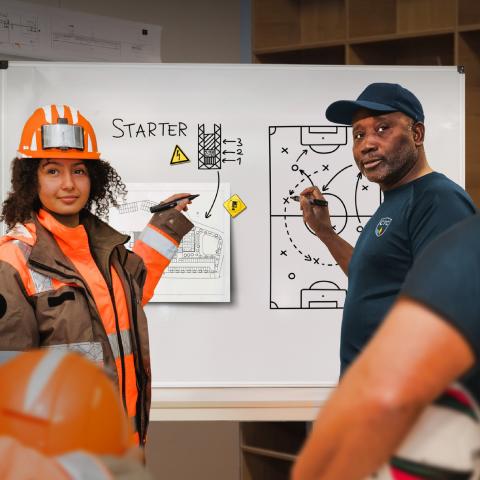
The fourth day, “RVL-me the company,” takes place at partner companies, where participants discover professional codes, deconstruct preconceived ideas, take part in mock interviews, and meet women with diverse career paths. We notably organized an “RVL-me Colas” day in February 2024.
Finally, the fifth day is dedicated to anchoring. The girls take part in a pitching workshop, attend another inspiring testimonial from a Role Model, and then present their project to around sixty Role Models from partner companies. The day ends with a closing ceremony.
How do you concretely involve professionals from partner companies in the process?
Athina Marmora: Role Models are supported and briefed beforehand and on the day itself, particularly on how to give feedback that is both demanding and caring. For the pitch sessions, we form around twenty trios of Role Models, with each trio listening to six young women in total. The pitches are very concrete: the young women share who they are, what they have learned about themselves, the work environment they aspire to, their career or project ideas, and the resources they need to move forward.
The Role Models then provide feedback on both content and delivery, highlighting strengths and offering practical recommendations. After the pitches, a networking session allows young women and Role Models to connect. At that moment, the energy in the room is usually very intense: around sixty young women and just as many professional women meeting—an experience that is powerful and transformative, including for the Role Models.
Muriel, how did you take part in this program, and what struck you most?
Muriel Voisin: I took part in the “RVL-me Colas” day as well as in the fifth day dedicated to pitches and meetings. I met young women who need support and encouragement, but I was also struck by their maturity, intelligence, and the richness of our exchanges. I was particularly impressed by their ability to synthesize and appropriate complex or unfamiliar concepts. During one meeting, a young woman managed to map out my role as CSR Director in the form of an incredibly clear drawing. I kept it and displayed it in my office!
What impact do these encounters have on the young women? What feedback do you receive?
Athina Marmora: Gratitude comes up very often: they are surprised and touched that so many women devote an entire afternoon just to them. This strengthens their self-esteem. They tell themselves, “If they come for me, it means I matter.” The exercise is stressful at first, but the supportive environment helps them relax. They leave with greater self-confidence, having taken on a new challenge and received positive feedback. They discover a diversity of career paths and professions and sometimes build connections that last over time.
In our impact report, we measure three levels: a change in self-perception; a transformation in how they interact with others; and their ability to project themselves into the future. By deconstructing limiting beliefs, we free up this ability to project. Concretely, after the program, contacting strangers to ask for an internship, for example, is no longer an obstacle.
It is also not uncommon for Role Models to stay in touch, support the young women, organize introductions, or help them find internships. One participant was able to complete an internship in diplomacy thanks to a Role Model who connected her with a diplomat friend, an extremely hard-to-access field. Sometimes, Role Models spontaneously take on a mentoring role. Years later, some participants tell us that a meeting during the program changed their life trajectory.
Muriel Voisin: One of the key aspects of our exchanges is sharing our experience and real-life stories. When I participated, I remember that the girls asked us many questions about our careers, particularly about balancing work and motherhood, which is a major concern for them. Our journeys show them that it is possible.
There are also very moving moments. I remember a young woman who wanted to become a psychologist to help people whose sexuality is not accepted by those around them. As we talked, she eventually confided that her own parents did not support her project. You could sense the link to a sensitive personal story. In such cases, you realize how much these young women need support and role models outside their family circle to be able to move forward.
Conversely, what is the impact on the Role Models?
Athina Marmora: We organize a debrief with them while the young women are in their closing circle on the final day. Many share an introspective reflection on their values, desires, and where they stand in life. The mirror effect is real: they sometimes recognize the teenager they once were, feel touched by the young women’s paths and vulnerabilities, experience gratitude, and leave feeling energized. There is also a sense of pride and belonging toward their company for supporting such a high-impact initiative.
Muriel Voisin: I myself was very moved and left feeling energized. I found these young women extraordinary. Their energy and potential deeply touched me. This experience confronts us with social inequalities and the long road to climb in the professional world, especially for women. These young women are driven and full of projects. They reflect back a very positive image of our own lives—something we sometimes stop noticing. It is an incredible benefit.
Athina Marmora : As Muriel just said, being a Role Model means first and foremost meeting young people we might not otherwise encounter, deconstructing prejudices, and regaining hope in youth. It also creates a sense of usefulness, transmission, and mutual inspiration by sharing successes or failures, which are all formative experiences. Beyond one’s daily professional life, you act for a cause and can sometimes positively and concretely influence a life trajectory.
Why is the engagement of partner companies like Colas and that of Role Models so important?
Athina Marmora: Our partner companies and their employees form a valuable ecosystem around these young women, who often accumulate social, territorial, and gender-based disadvantages. Our motto is “equality of dreams.” I truly believe that equality of opportunity first requires equality of dreams: you cannot dream of a profession you have never seen around you. If a young woman has never met a female site manager, how can she project herself into that role? By committing to Rêv’Elles, companies like Colas contribute to this equality of dreams. Through Colas Role Models, the girls were able to meet Muriel, a CSR Director, women working in Procurement, Legal, and Human Resources, as well as a Works Engineer and a Technical Director.
Muriel Voisin: It is an incredibly enriching experience. You do not need to have an exceptional career path to be part of this ecosystem Athina describes. Simply sharing your journey, explaining what you do, and taking the time to listen already creates meaningful exchanges. You also discover things about yourself through the eyes of these young women. As CSR Director, employee engagement is particularly close to my heart. This initiative generates mutual benefits; it is a positive experience for everyone involved. I would also like to emphasize that Colas Foundation’s mission of supporting the social and professional integration of young people is an integral part of our ACT (Act and Commit Together) corporate project, our eight CSR pillars, and more specifically our social pillar ACT5. Its objective is to attract, recruit, and retain the employees of tomorrow by offering working conditions that ensure health, safety, and well-being, while promoting diversity, equity, inclusion, and the development of employability and individual career paths.